

Employee benefits are often viewed as a modern HR invention. In reality, the idea of supporting workers beyond their wages dates back centuries.
From Roman military pensions to corporate wellness programmes and flexible work arrangements, benefits have continuously evolved alongside the workforce.
Understanding this history helps explain why benefits have become one of the most powerful tools for attracting and retaining employees today.
The Ancient Origins of Worker Benefits
The earliest examples of worker benefits can be traced back to ancient Rome.
Roman soldiers were often rewarded with pensions or land after completing their service. These rewards encouraged loyalty during service and provided financial security after retirement.
Although these systems were not identical to modern benefits programmes, they demonstrated a clear principle: long-term incentives strengthen workforce stability.
The modern story of employee benefits begins during the Industrial Revolution.
As factories expanded in the nineteenth century, employers needed reliable workers to operate increasingly complex machinery. To attract and retain labour, companies began offering practical incentives beyond wages.
These early benefits included:
- Company housing
- Access to company stores
- Basic welfare support
These initiatives were primarily practical solutions designed to stabilise labour forces and maintain productivity.
The First Modern Benefit Systems
One of the most important milestones in the development of employee benefits occurred in Germany during the late nineteenth century.
Chancellor Otto von Bismarck introduced one of the world’s first national social insurance systems. His reforms included:
- Worker health insurance
- Accident insurance
- Disability protection
These programmes established the foundations for modern social security systems.
Other countries soon followed.
In 1911 the United Kingdom introduced the National Insurance Act, providing workers with protection against income loss caused by sickness or unemployment.
For the first time, worker protection became both a government responsibility and a national economic policy.
Early Corporate Experiments
Before formal HR departments existed, some industrial leaders began experimenting with worker benefits.
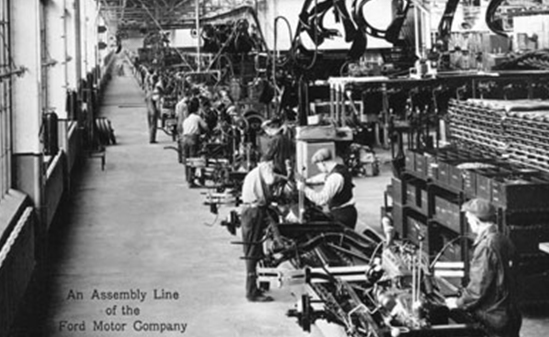
One of the most famous examples was Henry Ford.
In 1926 Ford reduced the factory workweek from six days to five, establishing the now familiar 40-hour workweek.
At the time, sixty-hour weeks were common in manufacturing. Ford believed that reducing hours would reduce worker fatigue and increase productivity.
His strategy worked. Productivity improved and other companies soon followed.
Today the five-day workweek is considered a standard feature of employment.
Welfare Capitalism and Early Corporate Perks
During the early twentieth century many corporations experimented with what became known as welfare capitalism.
Companies introduced benefits designed to build loyalty and reduce labour unrest.
Examples included:
- Subsidised cafeterias
- Company sports teams
- Housing programmes
- Early pension schemes
One of the earliest corporate pension plans was introduced by American Express in 1875.
These benefits encouraged long-term employment by rewarding loyalty and providing greater financial security.
The Post-World War II Benefits Boom
The most significant expansion of employee benefits occurred after World War II.
Factories were booming and millions of returning soldiers were entering the workforce. At the same time, wartime wage controls limited employers’ ability to increase salaries.
Companies responded by offering fringe benefits instead of higher pay.
These benefits included:
- Employer-sponsored health insurance
- Pension plans
- Paid vacation
- Paid sick leave
Government policy accelerated this shift.
In the United States employer contributions to health insurance became tax-exempt, encouraging companies to invest in benefits rather than wages.
Labour unions also played an important role by negotiating stronger benefit packages through collective bargaining.
By the 1950s employee benefits had become standard practice among large employers.
A good job was no longer defined only by salary. It was defined by the full employment package.
Wellness Programmes and the Expansion of Benefits
During the 1970s and 1980s companies began expanding benefits beyond healthcare and retirement.
One important development was the rise of corporate wellness programmes.
In 1979 Johnson & Johnson launched the Live for Life programme, one of the earliest workplace wellness initiatives.
The programme focused on improving employee health through:
- Exercise support
- Nutrition guidance
- Stress management
Over time wellness programmes expanded to include:
- On-site fitness facilities
- Health screenings
- Smoking cessation programmes
Employers increasingly recognised that healthier employees tend to be more productive and experience lower healthcare costs.
Flexible Work and Work-Life Balance
Another major milestone in the evolution of benefits was the introduction of flexible work arrangements.
Flextime policies first appeared in Europe during the late 1960s, allowing employees to adjust their working hours while maintaining the same total work commitment.
Advances in technology later enabled remote work and telecommuting.
Flexible work arrangements are now one of the most valued workplace benefits.
The COVID-19 pandemic accelerated this trend, proving that many jobs can be performed effectively outside traditional offices.
Mental Health Support in the Workplace
Workplace support for mental health has also evolved significantly.
Early employee assistance programmes focused mainly on alcohol treatment and substance abuse counselling.
Modern benefit programmes increasingly include broader psychological support such as:
- Therapy coverage
- Mental health days
- Employee assistance programmes
- Digital wellbeing tools
Employers now recognise that mental wellbeing directly affects productivity, engagement and retention.
The Future of Employee Benefits
Employee benefits continue to evolve alongside workforce expectations.
Many modern benefits focus on supporting employees’ personal lives beyond work.
Examples include:
- Student loan repayment assistance
- Expanded parental leave
- Flexible benefits packages
- Fertility and family planning benefits
- Pet insurance coverage
Pet insurance in particular is gaining attention as a workplace benefit because many employees view pets as family members.
Unexpected veterinary expenses can create financial stress. Providing access to pet insurance can help employees manage these costs while improving overall wellbeing.
Final Thoughts
The history of employee benefits reveals a clear pattern.
Innovative benefits begin as competitive advantages. Over time they become standard expectations within the labour market.
From Roman pensions to flexible work and modern wellbeing programmes, the goal remains the same.
Supporting employees beyond their salary is both humane and strategically beneficial.
Organisations that recognise this principle are better positioned to attract and retain talent in a competitive workforce.